410,000 Protest in France as Education Spending Drops 20%
Student-led demonstrations continue over poor school conditions and a 54-billion-euro cost-cutting plan, while the government seeks to balance a rising deficit against public demands.
By Chinedu Schneider ·
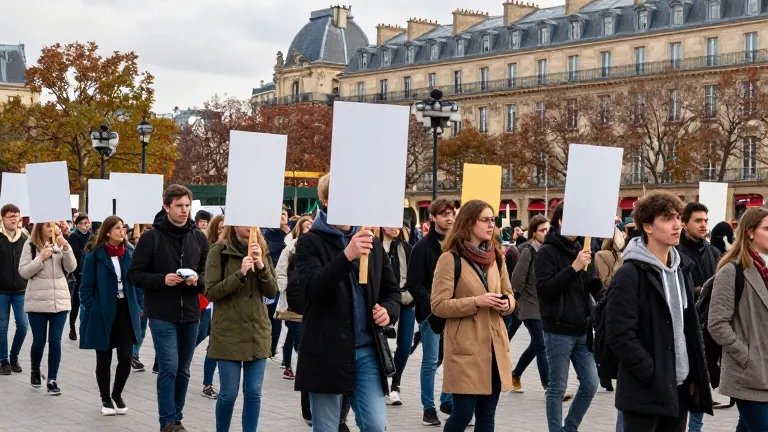
French authorities reported that 410,000 people demonstrated across the country on Saturday, with 110,000 gathering in Paris. The ministry of interior confirmed these figures as part of a nationwide wave of unrest that has persisted since mid-September. Protesters, primarily students, have blockaded campuses and waved signs demanding better facilities and a viable future. The demonstrations have expanded to include teachers and civil servants, reflecting a wider frustration with economic policy.
The unrest began when high school students blocked classrooms due to overcrowding, with some rooms holding between 32 and 35 pupils. Teachers joined the effort, citing low pay and long-term absences that have not been filled. Amine Snoussi, a journalist and former parliamentary assistant, described the conditions as dire. He noted that students study in cold, dirty buildings, some infested with rats, while thousands of teaching positions are cut. "That’s what lit the fuse," Snoussi said, adding that public money continues to flow to private schools despite these shortages.
The government has responded with curfews and a heavy police presence. President Emmanuel Macron blamed ultra-left groups for attempting to destabilize the state and threatened accountability for those involved in violence. However, a meeting between Macron and student representatives on Friday failed to ease tensions. Student leaders called for continued mobilization until the government provides concrete actions. Macron visited Marseille on Monday, where he stated he had asked the government to address the root causes of the protest movement.
Underlying these protests is a fiscal strain that limits the state's ability to spend. Data from economist Lucas Chancel shows that the public budget for higher education, student life, and research has fallen by 20 percent since 2017 when adjusted for inflation. The government is pushing a 54-billion-euro cost-cutting and tax package for the 2027 budget, which includes freezing civil servant salaries. Critics argue that students bear the brunt of these reductions as poverty rates hit multidecade highs.
France’s national debt has reached approximately 3.6 trillion euros, equivalent to 119 percent of its gross domestic product. The deficit is projected to hit 5.4 percent of GDP in 2026, well above the European Union average of just over 3 percent. Prime Minister Sebastien Lecornu acknowledged the anger of young people in a speech on October 7 and promised a plan to address the crisis by the end of the month. He has ordered ministers to review spending to manage the debt.
Economists offer differing views on the path forward. Thomas Piketty, a professor at the Paris School of Economics, wrote in Le Monde that reinvesting in education and health should be the priority. He argued that such spending would help the economy produce more output with fewer resources. Antonio Fatas, a professor at INSEAD, noted that France already has a redistributive system similar to other European nations. He suggested that the core issue is limited economic growth, which fuels demands for government support. Fatas warned that because government spending is already high among advanced economies, there is little room to simply spend the country out of this situation.
Source: Al Jazeera