Asian Stocks Mostly Advance as Wall Street Prepares to Reopen
South Korea led gains across major Asian markets Friday, while investors weighed interest in artificial intelligence stocks and potential damage from planned U.S. tariffs.
By Bianca Shevchenko ·
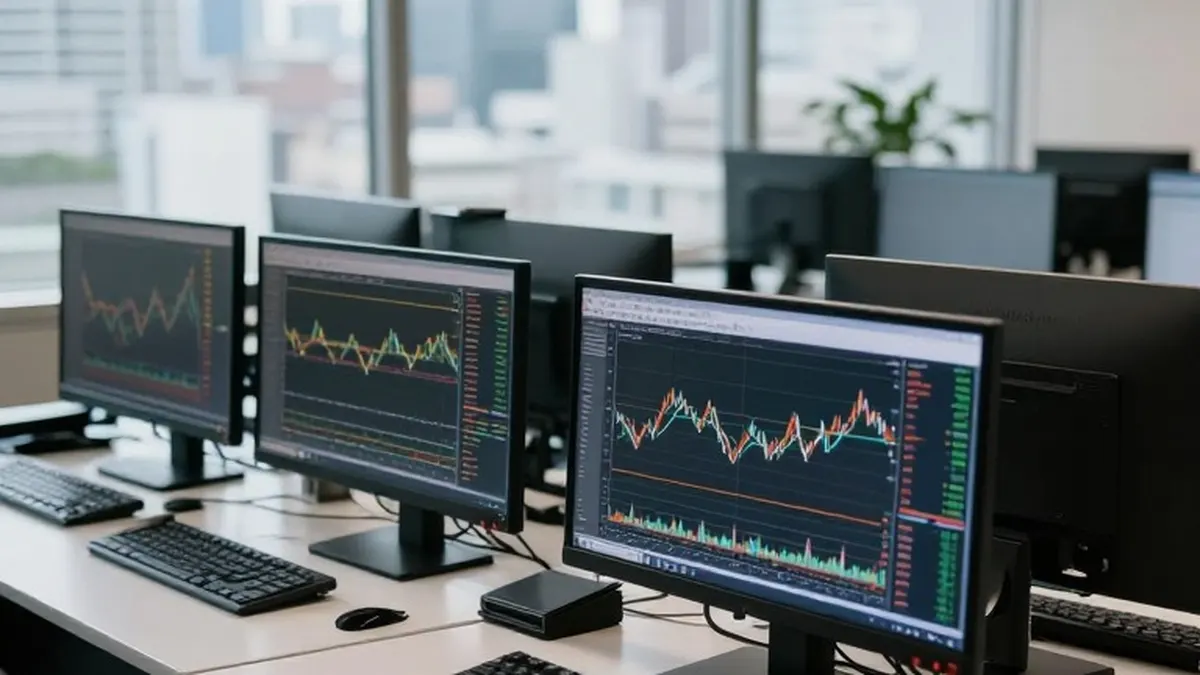
Asian stock markets mostly moved higher in early trading Friday, Nov. 27, as Wall Street prepared to resume trading after its Thanksgiving holiday. South Korea posted the largest percentage gain among the major regional benchmarks reported, while Shanghai edged lower. U.S. markets were scheduled to reopen later Friday for a shortened holiday session.
Japan's Nikkei 225 climbed 0.7% to 57,919.30 during the morning session. Australia's S&P/ASX 200 gained 0.4%, reaching 8,800.50, while South Korea's Kospi jumped 2.2% to 4,812.65. Those advances put all three benchmarks higher ahead of the reopening of U.S. markets, which had been closed for the Thanksgiving holiday.
Trading in Hong Kong and Shanghai followed different directions. The Hang Seng index in Hong Kong rose 0.4% to 22,310.11, matching the percentage advance in Australia's benchmark. The Shanghai Composite slipped 0.1% to 3,473.40, making it the exception to the upward moves across the other major Asian indexes reported.
Demand for shares associated with artificial intelligence has helped lift stock benchmarks, although investors taking profits have limited some of those advances. The continuing interest in AI-related companies remained a feature of regional trading, with chip stocks in Japan recovering after an initially weaker performance during the morning.
Tokyo Electron and Advantest Corp. both saw their shares fall before quickly recouping those losses. The reversals highlighted the continuing appeal of companies linked to computer chips and artificial intelligence. Their early declines and subsequent recoveries came as buying in the sector continued to support benchmarks despite some profit-taking.
Investors were also watching planned U.S. tariff increases affecting China, Japan, the European Union and other trading partners. Attention centered on the potential damage those measures could cause in the region, alongside the buying interest that has been supporting AI-related shares.
Oil prices moved in opposite directions after recent volatility tied to uncertainty over Middle East tensions. Benchmark U.S. crude increased 2.09% to $85.43 per barrel. Brent crude, the international benchmark, declined 0.29% to $96.29 per barrel.
Currency moves were modest. The U.S. dollar strengthened slightly against Japan's currency, rising to 159.25 yen from 159.23 yen. The euro weakened against the dollar, trading at $1.0967 compared with $1.0975 previously.
More News · National news · Report a business · Got a Story?