Tokyo Panel Reveals Unlikely Connections Behind Five Nippon Cinema Now Films
Directors in the Nippon Cinema Now selection described at the 39th Tokyo International Film Festival how chance meetings, direct messages and open creative freedom shaped their features.
By Bianca Shevchenko ·
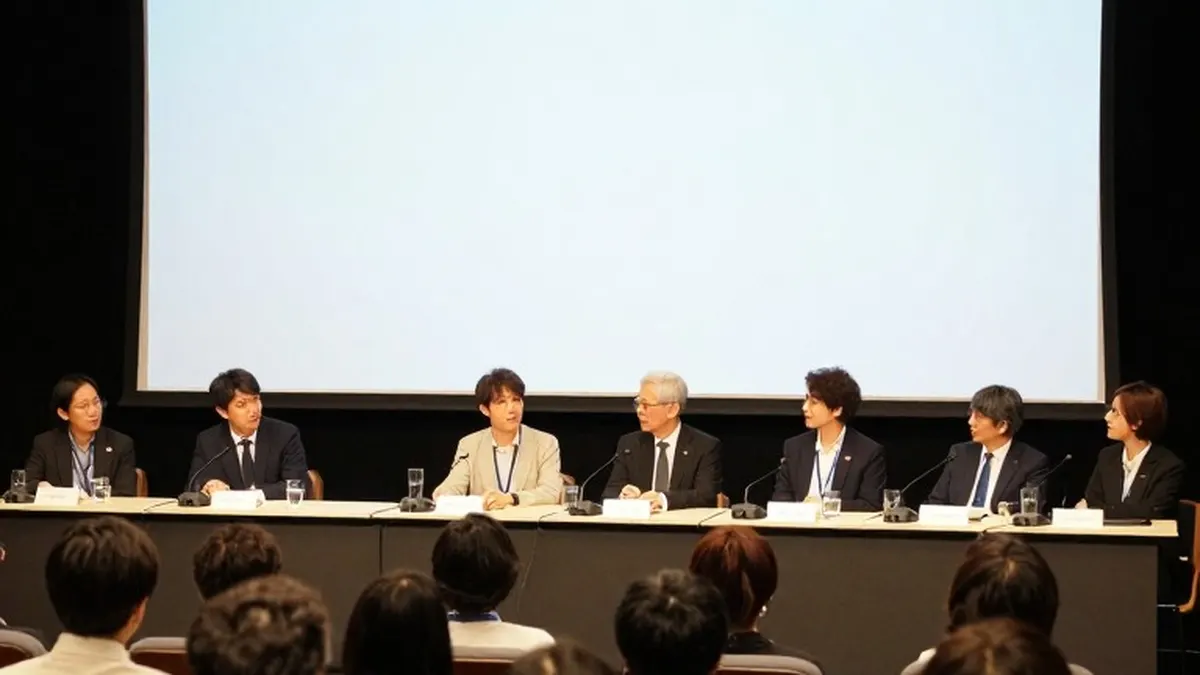
A first-time director who reached out directly to the cinematographer of an Oscar-winning filmmaker, and a former hunter whose film caught the attention of Carlos Reygadas, were among the speakers at a Nippon Cinema Now panel at the 39th Tokyo International Film Festival (TIFF).
The "How We Make Films" session took place at Tokyo Midtown Hibiya and was moderated by TIFF programming director Ichiyama Shozo. It featured Ueda Shinichiro ("Earthlings in Love"), Saito Kisin ("Kefi"), Natori Satoshi ("Chihiro | Akemi"), Matsumura Shingo ("Between Us") and Yaza Takenoshin ("Hinotama: Ball of Fire"), whose features differ widely in style and subject.
Ichiyama explained that the selection usually highlights newer directors in Japanese cinema, but he wanted Ueda on the panel because of the vertical format of "Earthlings in Love." Ueda said the film is a kind of adaptation of a 30-episode microdrama series made for social media, which explains the aspect ratio. Its budget was "equivalent to a regular independent film," he said, unlike most microdramas, which tend to be made cheaply. "I'm from the theatrical film world, so we were making it as if it were a film to start with," Ueda said, adding that this made it suitable for theatrical release.
Ichiyama described "Kefi," the debut feature from young cinematographer Saito, as "a very unique, strange film" in which "you never know what's happening, but at the end, it all comes together." Saito said the project began after he met a producer who handled production and movie advertising and who found a sponsor. The sponsor first supplied a theme, but later told the team they could make the film as they liked. "So it turned out to be a very strange film," Saito said.
The original theme was maternal love and being a mother. The finished film instead follows three sisters who learn that their father has died. Saito said the sponsors largely left it to the filmmakers, so he added his own preferences.
Natori spoke about the Hokkaido setting of "Chihiro | Akemi," a house in the eastern part of the island. A former hunter, he said he wanted to make a film about the distance between the woods and the house, drawing on the cycle of hunting: searching for prey, killing it and eating the meat, again and again. He compared that life with his own in Tokyo. Having worked as a director at an advertising company, he said the wilderness stripped away social roles and he felt his personality shift, as if another person were emerging inside him. Actor and producer Nawata Canon also brought her own experience of giving birth into the film, he said.
Natori named Andrei Tarkovsky's "Nostalghia" as a foundational influence, saying it taught him that "the plot is secondary." For him, texture, color and style carry as much weight as story. His film won the Grand Prix in the feature competition at the Split Film Festival in Croatia, where Reygadas was on the jury. Natori recalled that Reygadas told him, "Your film is crazy. What's going on here?" and expressed interest in working together. Natori said his next project could become a Japan-Mexico collaboration.
Freedom to follow their own instincts ran through the discussion. Matsumura said he had wide latitude with the concepts in "Between Us," which centers on theater and the overlap between theater and reality.
Yaza described how he came to work with cinematographer Kitagawa Yoshio, known for his collaborations with Hamaguchi Ryusuke. Having never made a feature or handled a budget, he said he messaged Kitagawa directly, curious because Kitagawa had also worked on many low-budget films. A conversation about filming on a tight budget led to a call in which Kitagawa offered to shoot the film and introduced a producer who began approaching financiers. It was Yaza's first time on a film set, and he was the youngest person there, but he described a generous, open-minded atmosphere.
Natori's closing thought summed up the spirit of the selection. "I think it's important for you to make a feature-length film that you will be satisfied by," he said, "that you can only do because it's your first time."
Source: Variety
More News · National news · Report a business · Got a Story?