State legislatures reshape election maps to secure partisan advantage
A new report details how the practice of gerrymandering has persisted since 1812, allowing ruling parties to maintain power through district design.
By Bianca Shevchenko ·
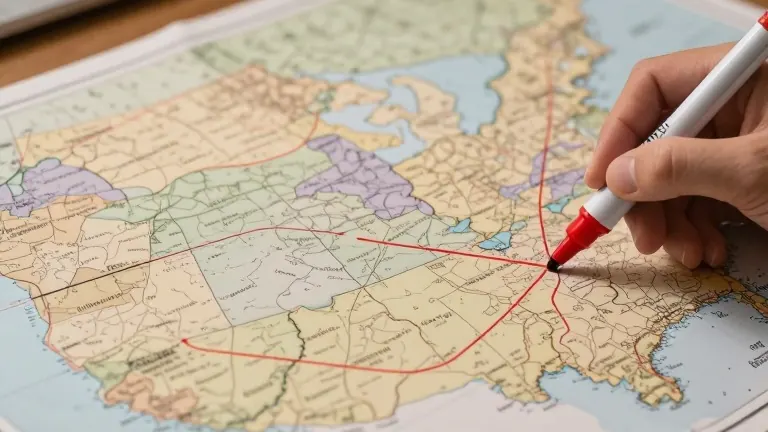
The practice of drawing electoral district lines to favor specific political parties has been a constant feature of American governance since 1812. A recent analysis confirms that state legislatures continue to use this strategy, known as gerrymandering, to tilt election outcomes in their favor. This long history demonstrates that the manipulation of district boundaries is not a new phenomenon but a recurring tool in the political arsenal. The data shows that winning a majority of the popular vote does not guarantee a corresponding majority in the legislature, a discrepancy often engineered through map design.
The origins of the term trace back to Governor Elbridge Gerry in Massachusetts in 1812. In that year, the state legislature redrew district lines to benefit the Democratic-Republican Party. Critics compared the shape of one resulting district to a salamander, giving the practice its name. Since that early instance, the method has evolved and spread across state lines. While the initial example was local, the concept became a national norm as parties sought to lock in advantages for future cycles.
Over the two centuries since 1812, both major political parties have employed gerrymandering when they hold legislative control. The source notes that no single party has a monopoly on the practice. When Republicans control a state legislature, they draw maps that favor Republican candidates. When Democrats hold that power, they draw maps that favor Democrats. This reciprocal behavior ensures that the side in power can often preserve its position, making it difficult for the opposition to gain a foothold in the next election.
The process relies on specific techniques such as packing and cracking. Packing concentrates opponents' voters into a small number of districts where they win by large margins but waste their votes. Cracking splits opponents' voter base across multiple districts, ensuring the ruling party wins those districts by narrow margins. These methods allow a party with 50 percent of the vote to win 60 percent of the seats, or similar disparities. The mathematical advantage is built into the map before any ballots are cast.
The current political climate sees renewed attention on these maps as states prepare for upcoming cycles. Legislators are tasked with redrawing boundaries after each census, a process that often sparks legal and public disputes. The source indicates that the 2026 cycle is part of this ongoing pattern of adjustment. Parties are analyzing voter data to refine their district shapes, aiming for the same structural advantages seen in previous decades. The goal remains consistent: to create a map that protects incumbents and party leaders.
As the 2026 election approaches, the impact of these maps will become apparent in the results. Voters in certain districts will have less choice than others due to the engineered safety of the incumbent. The source highlights that this history of manipulation continues to shape who holds office in Congress and state houses. The next few months will see the finalization of these lines, setting the stage for the contests that follow. The legacy of the 1812 Massachusetts maps is still visible in the current political structure.
Source: Cascade PBS