35% of Western Glacial Area Vanished Since Mid-Century
A new inventory shows the region lost a third of its ice volume and 300 distinct glaciers over the past seven decades.
By Bianca Shevchenko ·
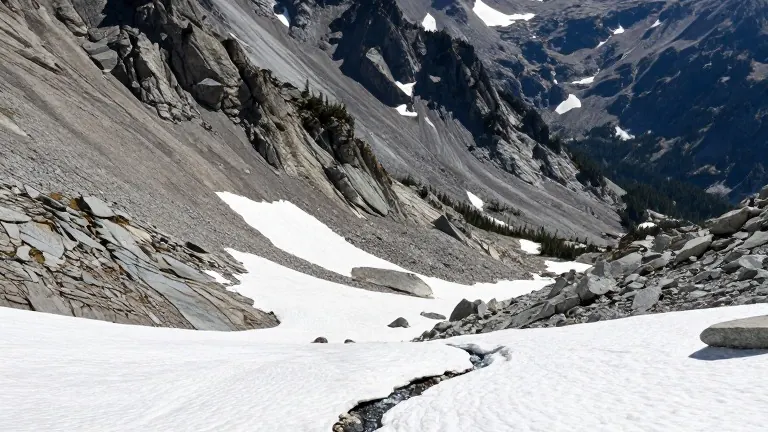
Western glacier area has contracted by 35% since the 1950s, according to a new study published in the Proceedings of the National Academy of Sciences. The research, led by Portland State University geology professor Andrew Fountain and the U.S. Geological Survey, provides the first comprehensive inventory of glacier area and volume across the western United States. The findings quantify the scale of ice loss in a region where glaciers serve as critical water reservoirs.
The study analyzed size and volume data for 1,331 glaciers, comparing current conditions to historical U.S. Geological Survey mapping data recorded between 1950 and 1980. In the 1950s, more than 1,450 glaciers existed across the West. The researchers determined that nearly one-quarter of those mid-century glaciers are now gone. The total volume of remaining ice has shrunk by 33%. If the lost volume were distributed evenly among the remaining glaciers, each would stand 38 feet shorter than it did in the 1950s.
Earlier analyses by the same team examined 612 federally recognized glaciers in California, Colorado, Idaho, Montana, Oregon, Washington, and Wyoming. That prior work found that 50 of those sites no longer meet the geologic definition of a glacier, which requires a minimum area of 25 acres. Among those 50, 25 were located in the Cascade Range and seven were in Oregon. Two federally recognized glaciers in Washington and Wyoming have disappeared entirely.
The distribution of remaining ice is uneven. Washington state holds 89% of the total glacial volume in the lower 48 states. The glacial cover on Mount Rainier alone exceeds the combined total of all other states. Despite this concentration, the Cascade Range glaciers in Washington and Oregon have lost 13% of their volume in recent decades. The Sierra Nevada mountains in California have suffered a more severe decline, losing 77% of their glacial volume.
Fountain stated in an email that these losses are tangible evidence of continued climate warming. Global average temperatures have risen by 2 degrees Fahrenheit since the 1850s due to greenhouse gas emissions from the burning of fossil fuels. The study notes that smaller glaciers reduce the flow of cold water to high alpine streams and riparian habitats, which are vital sources during the hot, dry late summer months.
Current conditions reflect this long-term trend. Snowpack levels in the Northwest and Cascade Range are among the lowest recorded since monitoring began in 1985. According to National Oceanic and Atmospheric Administration data, the region experienced its warmest fall on record last year.
Source: Lake Oswego Review