Pakistan marks historic milestone as first astronaut launches to space
Pakistani citizens gathered in Islamabad to watch the launch of Muhammad Zeeshan Ali, the country's first astronaut, aboard a Chinese spacecraft bound for the Tiangong space station.
By Bianca Shevchenko ·
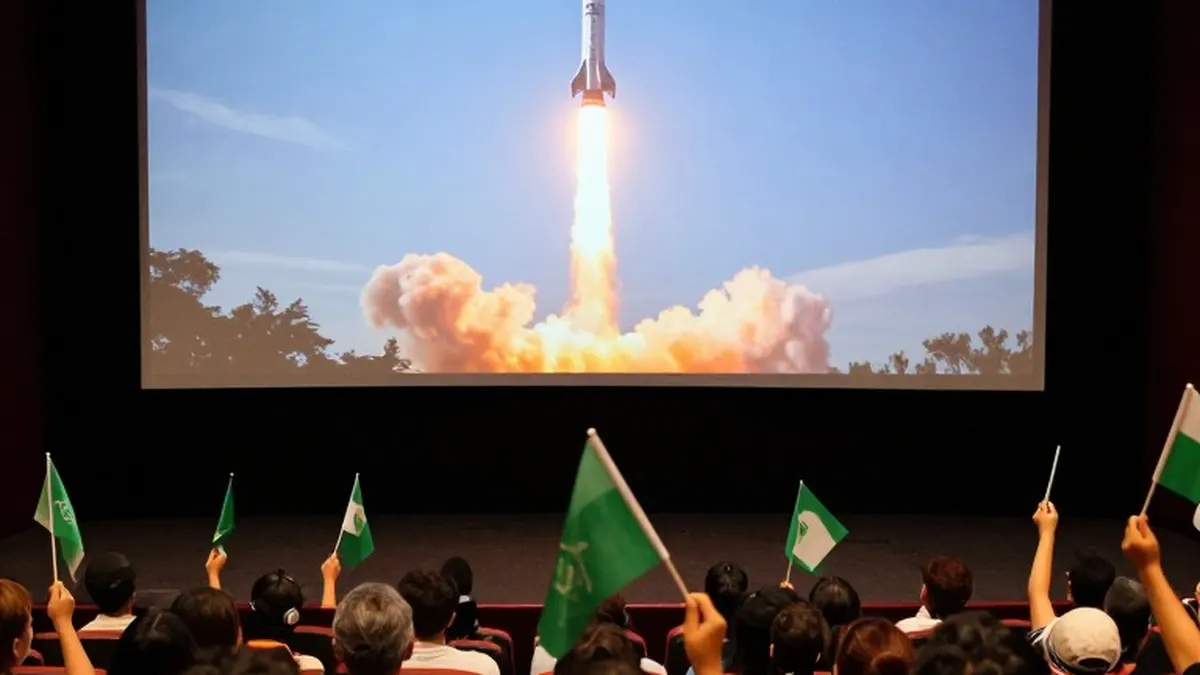
On the early morning of Wednesday, November 25, a large audience gathered in a chilly Islamabad auditorium to witness a historic moment for Pakistan. At 5:18 a.m. local time, a Chinese rocket carrying Muhammad Zeeshan Ali, the nation's first astronaut, ignited and rose into the sky. As the vehicle lifted off, the national anthem played, prompting the seated audience to stand and sing in unison.
The Long March-2F rocket departed from the Jiuquan Satellite Launch Centre in northwest China. The crew included Ali, a 40-year-old Pakistan Air Force pilot, alongside Chinese astronauts Tang Hongbo and Wu Yi. For the first two minutes after liftoff, the hall was filled with applause and chants of 'Pakistan Zindabad.' However, as the rocket became a distant dot on the screen, a tense silence fell over the room, a reaction attributed by some to the anxiety of waiting for confirmation of a safe launch.
Approximately ten minutes after the launch, the China Manned Space Agency confirmed that the Shenzhou-24 spacecraft had successfully separated from the rocket and entered orbit. The silence in the auditorium broke when hosts announced the success of the launch. A few hours later, officials from SUPARCO and the China Manned Space Agency verified that the spacecraft had docked with China's Tiangong space station at 8:56 a.m. The crew was scheduled to enter the station around 11:45 a.m.
The auditorium at the headquarters of the Pakistan Space & Upper Atmosphere Research Commission was packed well before dawn. Students and enthusiasts arrived as early as 4:20 a.m., with some sitting on the floor or standing against the walls. Many attendees held cards featuring Ali's portrait in a spacesuit, while others displayed flags and balloons of Pakistan and China. A brief moment of panic occurred when a YouTube advertisement appeared on the livestream screen just before liftoff.
Among the attendees was Zainab Abbasi, a 21-year-old physics and astronomy student at the National University of Sciences and Technology. She had traveled 40 kilometers from her home in Islamabad to be present, having spent the previous night at a relative's house. Abbasi, a member of the amateur astronomy group PakAstronomers, noted that she was so captivated by the moment that she forgot to record it on her phone, a stark contrast to the surrounding crowd.
The event highlighted a growing interest in space among Pakistan's youth. Ahzam Farooq, a physics student and vice president of PakAstronomers, recalled waking up at 3 a.m. for years to watch launches, often facing skepticism from his parents. Similarly, Adan Athar, a space sciences student, described being the first in her family to pursue an interest in the field, with relatives now believing she might become an astronaut herself.
Veteran astronomer Saif-ul-Islam Qureshi, a 72-year-old electronics engineer who helped found the astronomy society, emphasized that the mission represented more than just one individual. He described the event as a positive storm of excitement, noting that the presence of Ali symbolized the aspirations of Pakistan's younger generation. Qureshi has spent over 50 years observing the night sky and advocating for public engagement with astronomy.
SUPARCO chairman Muhammad Yousaf Khan outlined the country's future ambitions in a speech before the launch. He stated that Pakistan aims to reach the moon by 2035, with the first step being a lunar rover scheduled for flight in 2028. Khan expressed confidence that by taking steady steps and leveraging existing platforms, Pakistan could achieve significant milestones in space exploration.
Students present suggested that collaboration with China would allow Pakistan to build upon established infrastructure rather than starting from scratch. Farooq noted that utilizing Chinese platforms could facilitate further research through Pakistani satellites and astronauts. For the attendees, the successful launch served as a powerful affirmation of the country's potential in the global space arena.