Lander Woman Aims to Complete Winter of River Plunges
Felicity Hnilicka is recruiting local participants for cold-water immersion in the Popo Agie River, a practice she credits with building mental discipline.
By Chinedu Schneider ·
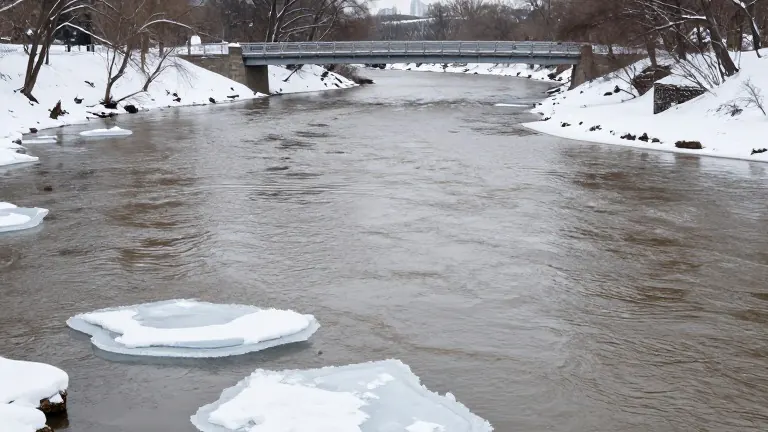
Felicity Hnilicka is attempting to complete her first full winter of cold-water plunges in the Popo Agie River.
The 24-year-old resident of Lander has practiced the activity for roughly three years but had never finished a season. She began her current campaign in November, aiming to continue through spring. Hnilicka is inviting other residents to join her at the City Park bridge near McManus. Her motivation is not merely physical endurance, but the development of mental toughness. She believes overcoming the urge to avoid the cold water translates to better stress management and daily productivity.
Hnilicka’s first major plunge occurred on a February morning in 2024 when the air temperature was around 16 degrees. She and friends entered the river before a day of skiing. The water was frigid, and their feet stuck to the rocks upon exiting. Hnilicka, a former personal trainer, says the practice has improved her sleep and circulation. She describes the initial resistance as a challenge to her will. 'If I can just say, "You gotta go, you gotta do it," then it’s also helped translate into not procrastinating my life events,' Hnilicka said.
Her routine begins with brief exposures in November, gradually increasing to five or 10 minutes in the colder months. She keeps her car running and a warm towel ready. The post-plunge sensation is described as a rush of excitement and relaxation. Her skin turns red, and her heart rate spikes. After weeks of practice, she reports better control over her breathing. Not all locals share her enthusiasm. Hnilicka recalls older residents in City Park laughing at the group for being crazy. Her mother also expresses concern about the risk.
The practice has gained adherents elsewhere in Wyoming. Kimberly Coats, who lives on a 600-acre ranch near Savery in Carbon County, tried the activity with her husband in January or February. They cut a hole through the ice in Savery Creek, where the water temperature was 32 degrees and the air was 20 degrees. Coats described a tingling sensation and a feeling of intense alertness. 'It was almost like this manufactured high,' Coats said. Her doctor later advised her to stop due to an unrelated medical diagnosis, but she maintains that the natural setting is a key component of the appeal.
Ward Dobbs, an assistant professor of kinesiology and health at the University of Wyoming, explains the physiological responses to cold immersion. The body experiences a stress response that accelerates the heart rate and breathing. Submerging the face in cold water triggers a reflex that slows the heart, creating a cardiovascular conflict. For healthy individuals, the body can tolerate this stress. Repeated exposure allows the body to adapt, similar to acclimatizing to heat. However, Dobbs notes that flowing river water removes heat from the body more rapidly than still water due to convection. Prolonged immersion can impair muscle function and coordination, posing risks even to strong swimmers. He advises gradual entry to mitigate the initial shock. Dobbs compares the practice to Finnish sauna culture, where alternating heat and cold is believed to aid blood flow. He cautions that while beneficial for some, the risks are real and require careful management of wind, water temperature, and current.