Aquarium Sized: Why Moon Water Limits Cities to 10,000
Harvard and Durham researchers calculated that existing lunar ice supplies can sustain a small town for centuries, but not a million-person metropolis.
By Bianca Shevchenko ·
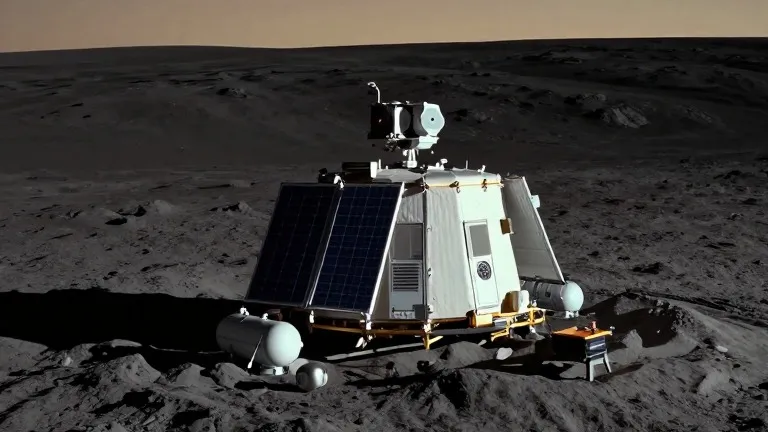
Martin Elvis and Jonathan McDowell concluded that the moon's available water limits sustainable human settlement to approximately 10,000 people. The senior astrophysicist at Harvard University's Smithsonian Astrophysical Observatory and the honorary professor at the Durham University Space Research Centre published their findings in Frontiers in Space Technologies this week. Their analysis challenges recent public statements by major space industry leaders regarding the scale of future lunar cities.
The study examines two critical resources for large-scale habitation: power and water. Elvis and McDowell determined that generating energy for one million residents is technically feasible using solar and nuclear sources. Water, however, presents a strict ceiling on population growth. Current estimates suggest the moon holds roughly one billion tonnes of water, located primarily in permanently shadowed polar regions where sunlight does not reach.
The researchers calculated that a population of one million would deplete these reserves in approximately 100 years. This projection assumes a 98 percent water recycling rate, a standard currently achieved on the International Space Station. In contrast, a settlement of 10,000 people could maintain the same water supply for centuries under identical conditions. Elvis described the total available volume as modest, comparing it to an aquarium the size of Central Park filled until the Statue of Liberty was just submerged.
The baseline figures for the study may be optimistic. Elvis estimated that the one billion tonne figure is likely 20 or 30 times too high. He suggested that only one-third to one-half of the existing water would be recoverable, potentially reducing the sustainable timeline for a million residents from 100 years to one. Gordon Osinski, a planetary geology professor at Western University, noted that satellite measurements remain uncertain. He speculated that the water might exist as sub-millimetre ice crystals mixed into soil, similar to Arctic permafrost, which would complicate extraction efforts.
These findings follow specific claims made by private space companies. In February 2026, Elon Musk stated that SpaceX had shifted its focus to building a self-growing city on the moon, a goal he projected could be achieved in under 10 years. Jeff Bezos of Blue Origin has previously claimed that millions of people will live in space by 2045. McDowell argued that while the water limits are a constraint, they do not invalidate the project. He noted that if the goal is to cover the moon with cities, engineers must find methods to transport water to those locations.
The study does not rule out lunar habitation, but it defines the scale of what is currently possible with in-situ resources. A small town remains a viable long-term option, while a sprawling metropolis requires a solution for water supply that has not yet been identified. The researchers emphasized that knowing these limits is essential for planning realistic infrastructure.
Source: CBC News