Israel recruits British doctors in London to fill workforce gaps
Government agencies hosted a job fair in a London community center to streamline licensing for foreign physicians while domestic restrictions on Palestinian medical graduates tighten.
By Bianca Shevchenko ·
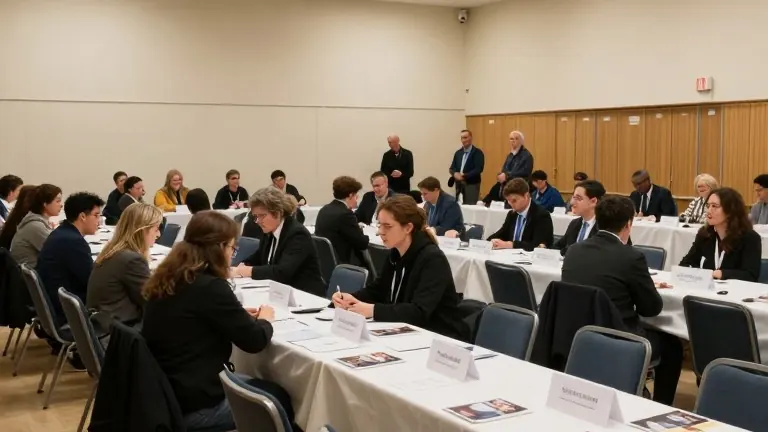
Israeli government agencies hosted a medical job fair in London on Sunday to recruit British doctors for positions in Israel. The event, titled MedEx UK, took place at a Jewish community center and was organized by Nefesh B’Nefesh, the Jewish Agency for Israel, and the Ministry of Aliyah and Integration. The drive is part of a wider effort to address a shortage of medical professionals in the country.
The recruitment effort is linked to the International Medical Aliyah Program, or Imap. Launched in 2020, the program aims to bring 2,000 doctors to Israel by 2029. Organizers use these job fairs to simplify the process for obtaining Israeli medical licenses for foreign nationals. Emails sent to participants indicated they would meet with representatives from Israeli hospitals and health funds. Attendees also had the option to take the YAEL Hebrew proficiency test, a requirement for medical licensure, on site.
An activist from Jewish Anti-Zionist Action who entered the event reported that attendees received materials from medical providers and health funds, including Terem and Clalit. These organizations operate centers in the occupied West Bank. A flyer from Terem listed facilities in the settlements of Modiin, Beit Shemesh, Ma’ale Adumim, and Beitar Illit. A list of attendees included representatives from Leumit Health Services, which a promotional video says runs medical centers and pharmacies in 30 communities across the West Bank. The list also included the head of obstetrics and gynaecology for the Israeli military.
The activist noted that prominent professors attended the event for one day before flying home the next. They added that Shivat Zion, an organization that assists British citizens relocating to West Bank settlements, was also present. Representatives from Clalit told attendees that the organization could provide medical placements and accommodation assistance in any location in Israel.
Middle East Eye contacted Nefesh B’Nefesh, the Jewish Agency for Israel, the Ministry of Aliyah and Integration, and Clalit for comment. None of the organizations responded by the time of publication.
The recruitment drive coincides with a sustained outflow of physicians from Israel. A recent survey by the Israeli Medical Association found that 1,369 doctors left the country for a period exceeding one year between 2023 and 2025. To counter this trend, the government has introduced financial incentives and streamlined licensing procedures for international hires. In 2025, the Ministry of Health changed regulations to allow doctors with 10 years of experience to skip the medical licensing exam. This reduced the previous threshold of 14 years. In 2026, the ministry allocated up to 240 million NIS, approximately $76.7 million, specifically for international medical recruitment.
At the same time, the Ministry of Health has implemented measures that limit the entry of Palestinian doctors into the Israeli healthcare system. The 2019 Yatziv Reform revoked recognition for medical degrees from countries not in the Organisation for Economic Co-operation and Development, including many Eastern European nations and Palestinian universities in the West Bank. While Palestinian citizens of Israel face barriers to entering domestic medical schools, and Palestinians from the occupied territories cannot enroll, many study abroad in non-OECD countries.
Despite these changes, the number of Palestinian doctors in Israel has risen in recent years. In 2023, they made up 25 percent of all physicians, up from 8 percent in 2010. The health ministry reported that Arabs and Druze constituted nearly 45 percent of newly licensed medics in 2023, compared to 18 percent in 2010. However, the number of new doctors entering the system is expected to drop this year because students who began studies in 2019 at schools no longer recognized by Israel are now graduating.
Shani Bar Tuvia, director of the health policy department at Physicians for Human Rights Israel, stated that the number of Palestinians among medical students in Israel has decreased to around 9 percent. She noted that this low percentage cannot become 45 percent of the doctorate. Bar Tuvia said the ministry is aware that the Yatziv reform means fewer doctors will be licensed and that it must compensate for the disqualified institutions. The ministry has also opened new medical schools at Ariel University and Reichman University to train more students domestically. Bar Tuvia described these schools as almost irrelevant for Palestinians.