Kazakh Tension: Tiger Return Threatens Pastures
Local livestock farmers worry about predation as Kazakhstan releases a second tiger into a protected reserve, prompting the deployment of mobile teams to manage human-animal conflicts.
By Bianca Shevchenko ·
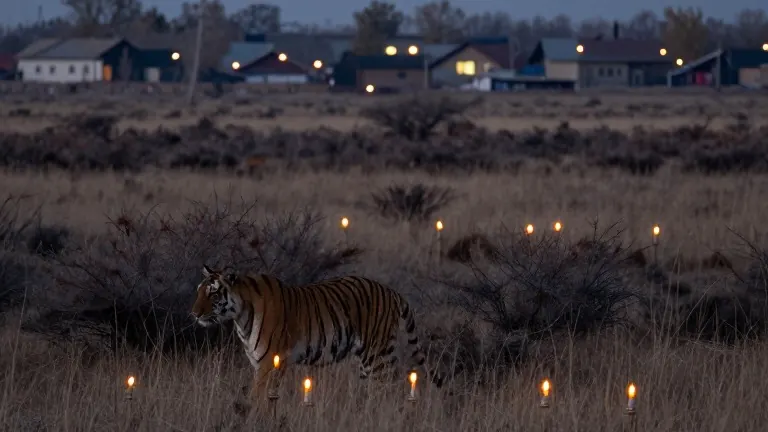
A clash between conservation goals and traditional livelihoods has emerged in the Ile-Balkhash State Nature Reserve. While government officials seek to restore a tiger population absent for decades, local residents worry that the apex predators will decimate their herds. The tension centers on a male tiger named Amur, released into the wild on November 2, who now shares the habitat with a female tiger named Umit.
The timeline of this reintroduction project spans nearly eight decades. By 1948, tigers had disappeared from Kazakhstan following hunting and habitat loss. The government established the reserve in 2018 and prepared the ecosystem by introducing over 200 deer and 100 kulans. Umit, a female from Russia, entered the reserve on July 31. Within ten days, she had hunted a boar and a wolf. Amur joined her on November 2, marking the first sighting of tigers in the country in about 80 years.
The immediate future involves active management of the animals' proximity to human settlements. Valery Bilyachenko, who operates a fishing base near the release site, noted that local opposition is strong due to the risk to cattle. The ecology ministry stated that satellite collars track the tigers' movements. Automated texts will alert villagers if a tiger comes within five kilometers of a farm. Furthermore, mobile anti-conflict teams are stationed to scare the animals away if they approach residential areas.
Alibek Kuantyrov, a representative of the Kazakh Ecology and Natural Resources Ministry, stated the goal is to establish a stable, breeding population rather than just returning the species to its historic range. Sergey Aramilev, director-general of Russia's Amur Tiger Center, described the initiative as a signal to the world that restoring historically extinct large mammals is possible. The project costs 30 million dollars and is funded by the World Wildlife Fund, the UNDP, and Kazakhstan.
Two additional young tigers are scheduled for release in 2027. The long-term target is a population of approximately 50 tigers roaming the Kazakh wilderness. Experts assess the chance that the current pair, Amur and Umit, will mate as small. Bilyachenko predicts limited immediate impact on his business but acknowledges that the presence of tigers may limit outdoor recreation for locals as the population grows.