Khadim Dai’s Documentary 'Hazara Town' Chronicles an Afghan Refugee Family in Quetta
The director’s first feature length film observes his own relatives as they navigate life in Pakistan while waiting for family reunification in Canada.
By Bianca Shevchenko ·
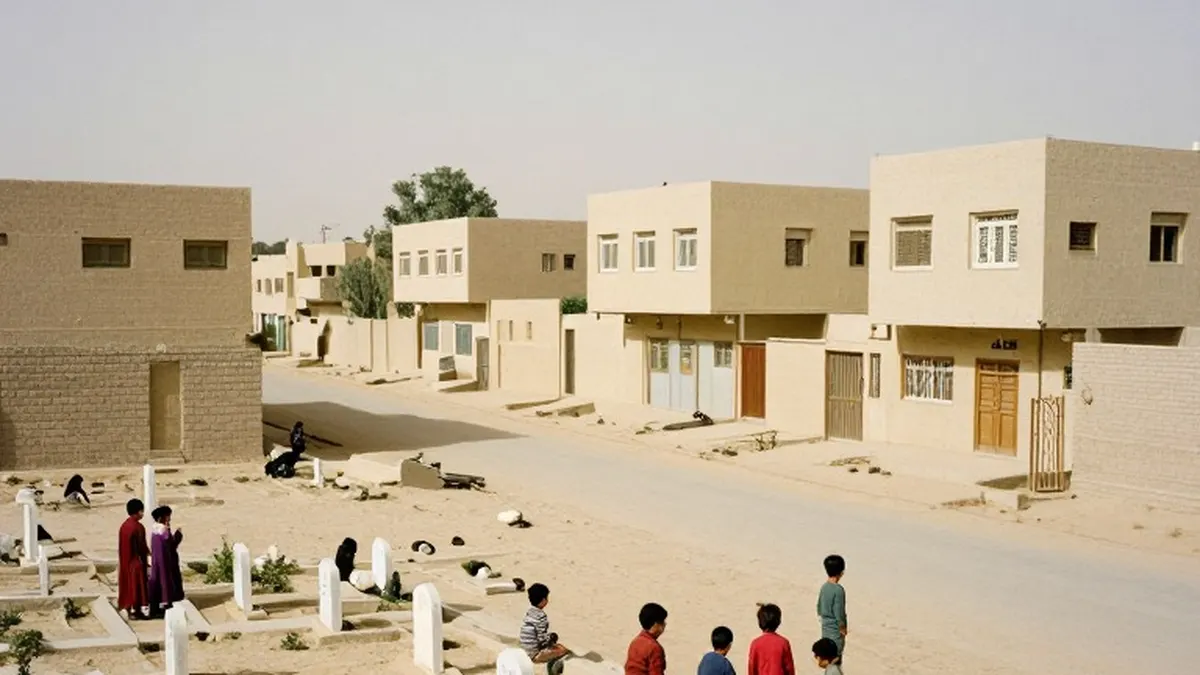
A thick layer of dust settles over the Pakistani desert city of Quetta, turning the landscape into a uniform shade of bleached beige. This muted palette reflects the state of the local quarter of Hazara Town, a settlement named for the ethnic Hazara community where over half a million displaced refugees reside. These residents find themselves in a state of indefinite limbo, feeling unsafe in their current location yet not yet granted asylum elsewhere. Khadim Dai’s documentary, Hazara Town, captures this complex holding pattern, showing how everyday domestic life continues despite the surrounding uncertainty.
This is the first feature length film from Dai, an Afghan born director based in Los Angeles. The project is deeply personal, focusing on his own family members who remain stranded in Quetta after fleeing Afghanistan. The central figures include his sister in law Sedeqa, her two young nieces Machid and Mitra, and their grandparents. Their brother in law, Hussain, has already moved to Canada to establish a new life. However, the process of following him is slow and selective, causing significant portions of the family’s life to pass by while they wait for reunification.
The separation has a profound impact on the younger generation. Preteen Mitra has little memory of her father’s presence at home, and digital communication only partially bridges the emotional gap. Dai returned to Pakistan several years after his own departure to embed himself in the household. His camera captures the intimate routines of the family, highlighting the growth of the two girls in the absence of their father, while also documenting the wider currents of fear within the Hazara community.
The film portrays a community that feels increasingly unsafe from ethnic and religious persecution, similar to the conditions in their homeland. Targeted killings are a disturbingly common occurrence, with a rising death toll appearing on screen without extensive commentary. Rather than recording the violence directly, Dai spends considerable time in the local cemetery, where the dead are buried with minimal ceremony. Portraits of the deceased are displayed briefly as memorials before they too disappear.
The sound design in the film balances the lonely sounds of the desert wind with the rhythmic tapping of local stonemasons working on grave markers. The cemetery serves as more than just a place of grief; it acts as a gathering spot for a community granted little social space. Some of the most poignant scenes show children chatting and playing amongst the humble resting places, creating a sense of life within the space of loss.
The family residence offers a sense of security in an otherwise stateless existence. The home, with its modest courtyard and few windows, is turned inward. While the girls attend school, their freedoms are limited as Pakistan transfers responsibility for refugee education to the Taliban. It is within the cramped domestic walls that Machid and Mitra assert their evolving personalities and interests, maturing rapidly before the camera.
Machid is a studious student who loves Judy Blume and dreams of education opportunities in the United States. The rest of the family, however, pins their hopes on Canada, encouraged by cheerful video messages from Hussain describing the cultural and weather differences. Good news eventually arrives from North America, but not for everyone, leading to further fragmentation of the family unit.
Dai films the individual departures from the back window of a taxi, where a bucket of water is splashed for good luck. The drips distort the final view of those left behind in the rearview mirror. Despite the lack of a tidy resolution, the film offers a temporary interlude of reunion before life pulls in multiple directions. It stands as a quietly emphatic statement of presence for lives that are easily dismissed as statistics, finding a shred of hope amidst the anguish of movement and stillness.
More News · National news · Report a business · Got a Story?