Space Science: Trace Dominguez Explores Black Hole Physics
The Star Gazers host guides viewers through a thought experiment regarding the physical effects of falling into a black hole on a moonless world.
By Bianca Shevchenko ·
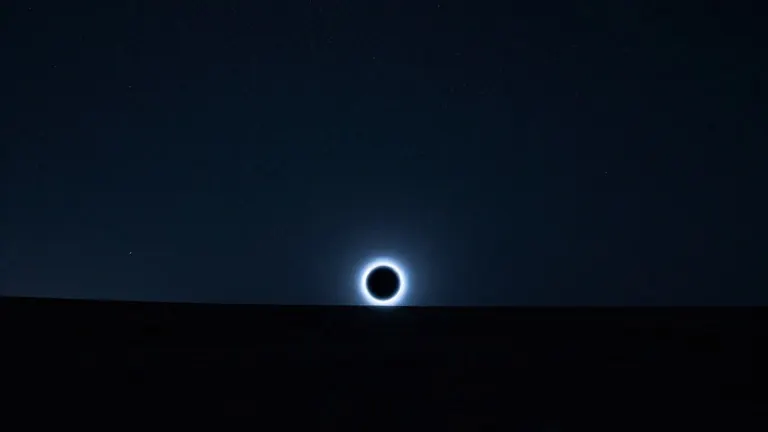
Star Gazers host Trace Dominguez presented a detailed thought experiment on the physical experience of falling into a black hole. The segment aired on Cascade PBS and is part of the station's ongoing science programming.
Dominguez framed the scenario by setting the viewer on a moonless world. From that vantage point, he examined the gravitational forces at play near a black hole. The presentation avoided complex equations in favor of visual and conceptual explanations.
The core of the report focused on the intense radio noise detected from deep space. While the source material lists this as a separate discovery, Dominguez used it to contextualize the electromagnetic environment surrounding these cosmic objects. He explained how such signals help scientists map the boundaries of black holes.
Dominguez noted that black holes are not voids but regions of extreme density. He described the event horizon as the point of no return. Once a cross that threshold, the gravitational pull becomes too strong for light to escape. This characteristic defines the object's name and its role in the universe.
The host also referenced the Nancy Grace Roman Space Telescope. He highlighted its potential to observe black holes with greater precision. The telescope is designed to capture large areas of the sky at once. This capability will allow researchers to study the distribution of dark matter and black holes in more detail.
In a related segment, Dominguez discussed the Trojan asteroids. He described these as mysterious space rocks that orbit with Jupiter. Scientists believe these asteroids hold clues to the early solar system. Their composition offers a snapshot of the conditions present during the formation of our planetary system.
The program also touched on the Perseids meteor shower. Dominguez called it one of the most dazzling displays of the year. He provided viewing tips for sky watchers. The shower occurs when Earth passes through debris left by Comet Swift-Tuttle.
Dominguez recalled the moon landing of July 20, 1969. He described it as a moment when humanity achieved the unthinkable. The segment connected this historical milestone to current plans for returning to the moon. NASA and its partners are preparing for new crewed missions in the coming years.
The host explained that spacecraft do not rely solely on rocket power. They use planets to gain speed through gravity assists. This technique allows probes to travel further with less fuel. Dominguez used the Juno mission as an example. The spacecraft used Jupiter's gravity to adjust its trajectory and study the planet's atmosphere.